Falsely Accused of School Violence: Securing a "No Disposition" Decision in Juvenile Court
26-06-23 213
본문
1. Case Overview
The client, an elementary school student, was unjustly reported for allegedly hitting a peer. The matter was treated seriously, and a hearing was initiated at the competent family court as a juvenile protection case, putting the young student at risk of receiving a protective disposition.

The most critical unique aspect of this case was that the client was not the perpetrator, but rather the clear "victim." While physical contact did occur, it was an unavoidable defensive action taken as the client struggled to escape harassment from the other students. In this unjust situation where the victim was framed as the perpetrator, it was urgently necessary to correct the facts so that the young child would not be left with a record of a protective disposition.

Law Firm Theo systematically responded as follows to prove the substantive truth of the case and clear the client's name:
- Securing Objective Evidence: We quickly secured CCTV footage capturing the situation at the time of the incident and collected and analyzed statements from people present at the scene.
- Clarification of Justifiable Defense Action: Based on the secured objective evidence, we made it clear that the student was not the perpetrator. We specifically proved the contextual circumstances where physical contact inevitably occurred while the client was struggling to escape the perpetrators' actions.
- Submission of Counsel's Opinion and Oral Argument: We submitted a counsel's opinion organizing these facts legally to the court, and the attorney in charge attended the hearing in person to strongly argue for the client's innocence orally before the judge.

4. Result of Assistance
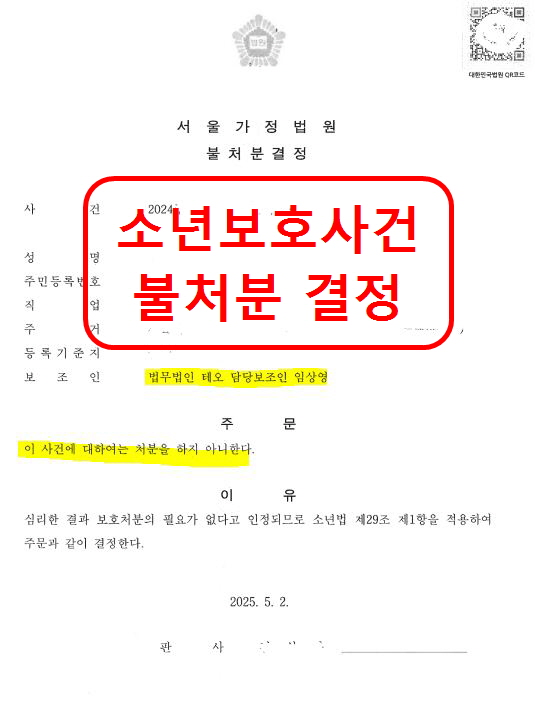
The court fully accepted Law Firm Theo's valid arguments and supporting evidence. As a result, the court determined that there was no need to impose any protective disposition on the client and issued a final decision of "No Disposition," not even imposing the lightest Type 1 disposition. Consequently, the elementary school client, who had been unjustly subjected to a juvenile trial, was able to safely return to their daily life without any disposition.

------------------------